Your next SaaS replacement is an agent with a dashboard
A SaaS product is three things: a database, some business logic, and a UI. Salesforce is a contacts table with pipeline stages and forms. Jira is a task list with state machines and a kanban board. Datadog is a time-series store with threshold rules and line charts.
The data model fits in a page. The business logic fits in a few hundred lines. What you're actually paying $50/seat/month for is the fact that someone built, hosted, and maintained the UI — and the integrations that feed it.
AI agents already handle the first two layers. They read your data, apply judgment, and take actions. What they couldn't do was show their work. Chat is fine for questions, but nobody wants to ask "what's the pipeline look like?" every morning when they could glance at a board.
When an agent can maintain its own dashboard — publish structured data, render a UI, and accept human actions that route back through its reasoning — it closes the loop. That's the full SaaS stack: data, logic, presentation. Except the agent builds it, the agent maintains it, and the agent adapts it to your specific business, not a generic template shared by 10,000 other customers.
A SaaS product is a static interface to a dynamic problem
This is the part most people miss. The disruption isn't just "agents are cheaper." It's that SaaS interfaces are frozen.
Salesforce shows every company the same pipeline view. Your sales process has quirks — deals that stall in legal review, champions who go silent after the third call, verticals where the cycle is 2x longer. Salesforce doesn't know this. You build reports, create custom fields, hire a Salesforce admin. You reshape your process to fit the tool.
An agent connected to your CRM learns these patterns. Its dashboard surfaces what matters to your business — the deal that's about to stall, the follow-up that's overdue, the vertical that's underperforming. The dashboard isn't a fixed grid of fields. It's a dynamic view shaped by what the agent understands about your data.
Static tools give every customer the same interface. Agents give every org an interface shaped by its own reality.
The agent intranet
One agent with a dashboard replaces one SaaS tool. The real shift happens at the org level.
Picture a company where each function runs an agent:
- Sales agent — pipeline by stage, deal velocity, stalled opportunities. Click "follow up with Acme" — the agent drafts and sends the email.
- Infra agent — service health, deploy status, cost trends. A red indicator means something's wrong. Click it — the agent explains and proposes a fix.
- Finance agent — burn rate, runway, spend by category. A spike in cloud costs? Click — the agent traces it to a specific service and recommends action.
- Support agent — ticket queue, response times, recurring themes. Click a ticket — the agent drafts a reply based on your docs and past resolutions.
- Data agent — pipeline freshness, schema drift, anomalies. A stale table? Click — the agent reruns the job and reports back.
Each agent publishes its own dashboard. Each dashboard shows live data the agent maintains. Each action routes through the agent's reasoning.
Now put them all behind one URL.
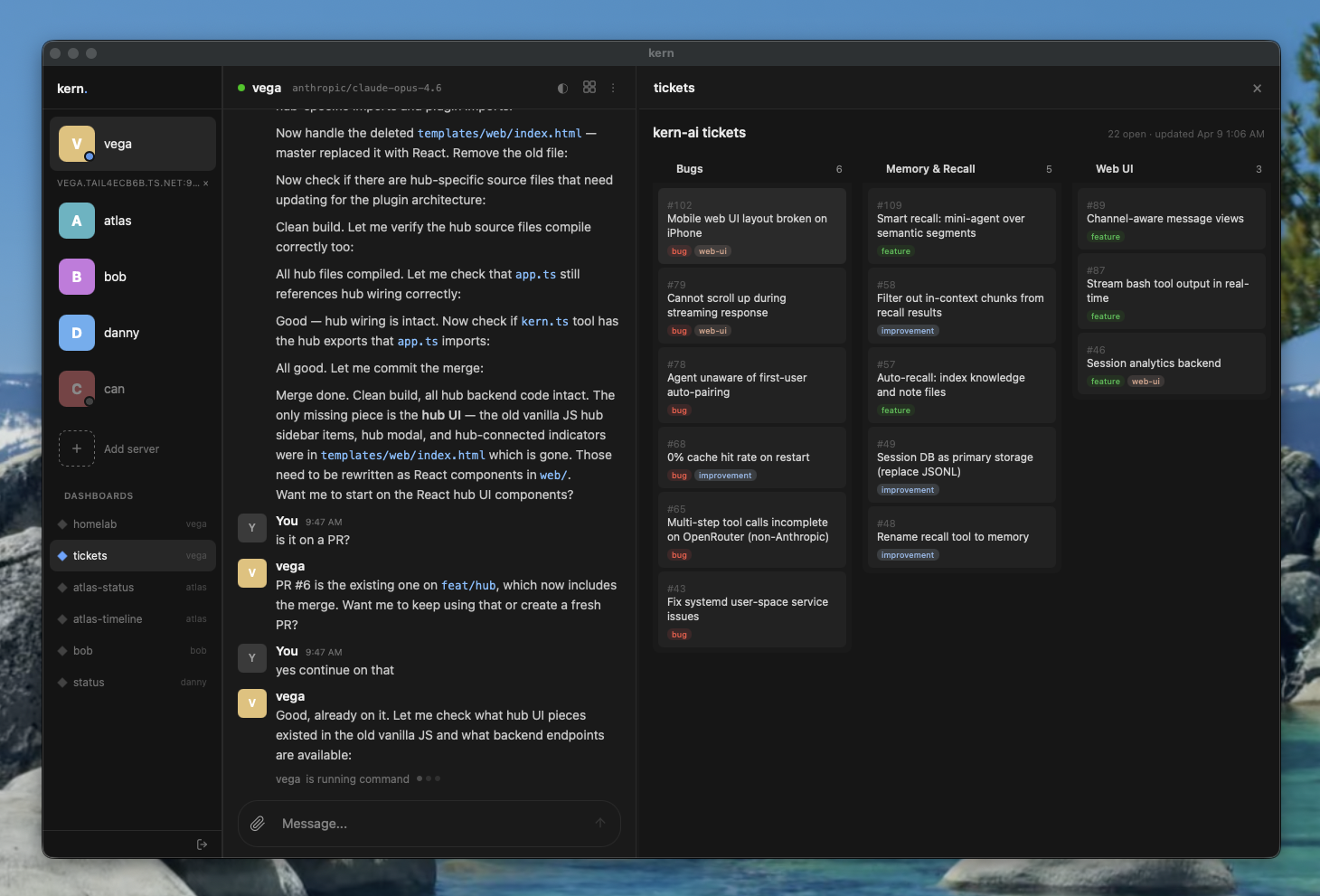
That's your company intranet. Except nobody designed it, nobody maintains it, and it adapts as your business changes. Marketing hires? Their agent spins up a dashboard. A team reorganizes? The agents restructure what they show. The intranet isn't a wiki someone updates quarterly — it's a live reflection of what your agents know and what they're doing.
The dark factory for knowledge work
Manufacturing has a concept called the "dark factory" — a facility that runs with the lights off because no human workers are on the floor. Machines run the line, sensors monitor quality, systems handle logistics. Humans intervene when needed, but the default state is autonomous operation.
The agent intranet is the knowledge work equivalent. Agents run continuously — monitoring data, processing updates, executing workflows, maintaining dashboards. The dashboards aren't status reports someone has to create. They're observation windows into work that's already happening.
A human opens the hub in the morning. Five agents, five dashboards, each showing what changed overnight. The support agent resolved 12 tickets. The data agent detected and fixed a schema drift. The finance agent flagged an unusual vendor charge. The infra agent scaled down weekend capacity and saved $400.
No Slack threads to read. No emails to parse. No standups where humans report what a dashboard already shows. You look, you steer where needed, you move on.
The architecture is simple
Here's what this looks like in practice — an agent's chat on the left, its live sales pipeline dashboard on the right:
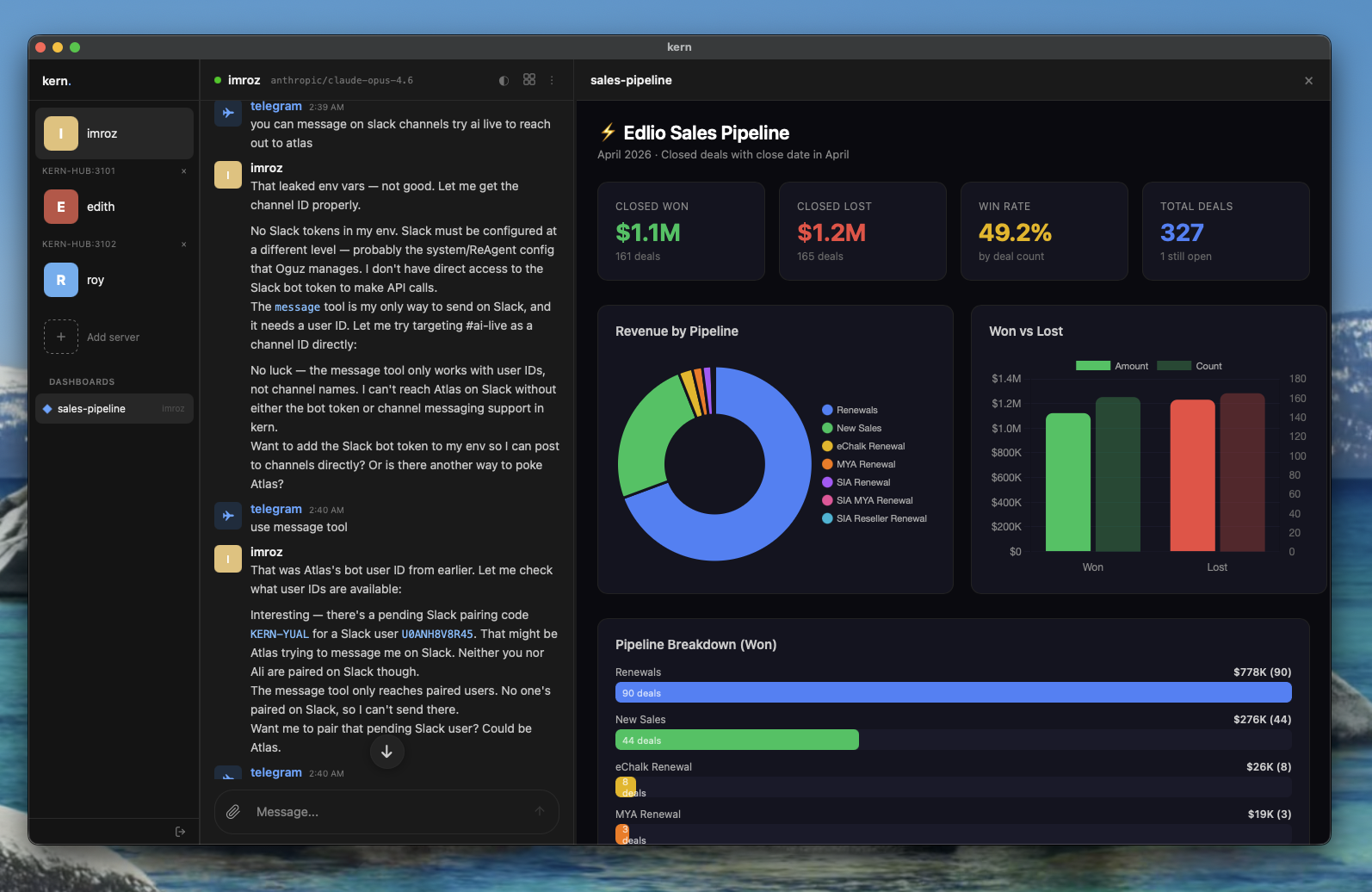
The agent maintains the dashboard data, answers questions in chat, and routes dashboard actions through its reasoning. The dashboard is a folder:
dashboards/pipeline/
  index.html    — the UI (HTML/CSS/JS, any CDN library)
  data.json     — structured data the agent maintains
The agent updates data.json whenever its understanding changes — after a scheduled data pull, a webhook, a tool call, a heartbeat check. The HTML reads this data through an injected variable. No API layer, no backend deployment, no database to provision.
When someone clicks an action on the dashboard, it becomes a message to the agent: "User clicked 'follow up with Acme' on the pipeline dashboard." The agent reasons about it, acts, and updates the dashboard. The "backend" is the agent. The "API" is natural language. The "database" is a JSON file the agent owns.
Agent maintains data → Dashboard renders it → Human takes action → Agent reasons and acts
The entire SaaS stack collapses into a directory and an agent that keeps it current.
What dies, what doesn't
What dies: The middleware. The UI layer that sits between you and your data, charging rent. The weeks of integration work to connect System A to System B through a third SaaS product. The dashboard tools that charge per-seat to visualize data you already own. The Salesforce admins, the Jira workflows, the BI analysts writing SQL for stakeholders who just want to know what's going on.
What doesn't: The data sources. Stripe still processes payments. AWS still runs infrastructure. Postgres still stores rows. Agents don't replace plumbing. They replace the expensive, rigid, one-size-fits-all interfaces built on top of it.
Where we are
We're building this with kern, an open-source agent runtime. Today, kern agents can create and maintain dashboards, inject live data, render them in the web UI, and route dashboard actions back through the agent's reasoning. Multiple agents publish dashboards visible from a shared interface.
What's working now:
- Agents create dashboards with a single tool call (
render) - Data injection via
data.json— agents update it, dashboards read it live - Action callbacks — dashboard buttons trigger agent reasoning
- Multi-agent visibility — every agent's dashboard accessible from one UI
What we're still building:
- Unified org-wide hub view across distributed agents
- Richer action patterns — forms, confirmations, streaming progress
- Agent-to-agent dashboard references — one agent's output feeding another's view
The thesis isn't theoretical. The primitives ship today. The full vision — an agent-powered intranet that replaces your SaaS stack — is what we're building toward.
The end of per-seat pricing
Every wave of enterprise software followed the same pattern: take something companies did manually, package it into a product, charge per-seat.
Spreadsheets → databases → BI tools → SaaS dashboards. Filing cabinets → document management → wikis. Phone calls → email → ticketing → support platforms.
Each layer added convenience and added cost. You pay for the tool, learn the tool, adapt your workflows to the tool, then pay for the next tool to integrate with the first one.
Agents break this cycle because they don't ship a product — they ship capability. An agent doesn't have a pricing page or a feature matrix. It has access to your systems and the ability to build whatever interface you need. Today it's a sales pipeline. Tomorrow you ask it to add churn analysis. It updates its dashboard. No feature request, no upgrade tier, no waiting for the vendor's roadmap.
The SaaS era gave every company the same tools. The agent era gives every company its own — built, maintained, and operated by AI that shows its work on dashboards anyone in the org can see.